Intro
I finish prospecting the tail of the long pool and get out of my self-absorption. Somebody wants to surprise me switching the cicadas on again; oddly enough just a moment ago I was deaf to that hellish roar!
Nothing.
I resume scanning, switching off those crazy insects.
Close to the head of the pool and just about to give up, I see the fish: a big chomp breaking the quietness of the surface reveals a beautiful brown trout patrolling the opposite bank along a wide patch of sluggish water, peppered with every kind of floating vegetal debris imaginable.
Succinct references about this river from two different sources agreed on the fundamentals: don’t judge it by its lower stretches; you have to walk several kilometers to reach its sweet parts.
So up we have gone, keeping the roaring torrent jumping and hurrying up among huge boulders down there at our right side. Nobody would guess that a water of such a wild character —much more suitable to whitewater kayaking than to fishing—, might sustain more than a few small trout. Anyway, most of what you experience fishing wise in New Zealand seems to be the opposite of what you would expect back home, so, already used to this weirdness, we accept any apparent inconsistency without suspicion.
Even this early in the bright summer morning, under the thick canopy of this wild forest humidity seems to be resolutely committed to reach boiling point. The fact that this route is pretty popular among mountaineers doesn’t make it easier to walk. Its equivalent in most of Europe would be a trodden path whose only challenge is a steady gain of altitude; here it isn’t much more than a trace, criss-crossed now and then by gullies and corpses of big fallen trees that you have to negotiate as best as you can: bending over, climbing up or both. It is not a walk in the park, so trying to keep up with the pace of my young buddy with a backpack thirty years older than his, is a feat I won’t be able to sustain for long. I philosophize about our culture having reached a point in which a totally natural forest may look so unnatural, and what that implies in the whole matter of life.
A couple of hours later, the track reaches a stretch where the river runs through flat terrain for the first time, forming a weird combination of pools. No trace of Álvaro, though. “He has gone further up” —I say to me.
The track gets away from the bank again and although it never gets too far from the river, the jungle you have to cross to get to the water is deterring enough. I eventually reach a couple of easy access points. Nobody at sight. Forced to make a river crossing I find footprints from a pair of boots on the beach of the left bank. “He has crossed here too” —I say to me— and go on.
When the landscape develops a truly alpine character I must accept my stupid mistake: I have obviously missed the access where Álvaro has entered the river. Even worse, I haven’t made a single cast so far, and although I don’t have a watch—another stupid mistake—, it looks like I am running out of time. To help in keeping high spirits I am about to run out of water as well; the only filtering bottle we have got is in my buddy’s pack and giardia isn’t something to take lightly. As the old Spanish saying goes: wasting powder in artillery salutes. Great!
After a while of grumbling my way downward I reach the last pool I saw when climbing up, now turned into the first opportunity of the day. Giving it a wide berth I start at the tail, a long piece of relatively shallow water as clear as mountain air, that appears devoid of fish life. The head of the pool looks interesting, though, with big rocks scattered under pretty deep water. A few random casts with a foam beetle to prospect the area achieve nothing. On the last one, something attracts my attention to the opposite bank; while looking away, from the corner of my eye I see a big ring of water just where my fly is. Of course, I miss the take. If we learn from mistakes I am an obvious exception to that rule. Definitely this is not my day.
Farther downstream I eventually find another access to the river. The first promising water of this section appears to be empty, but I see another nice looking pool in a secondary channel. It is small, dark, shaded from the fierce afternoon sun by the overhanging branches of a big tree which rises up from the opposite bank. Standing still I take my time, observing…
Uh! Like the subtlest brushstroke of a watercolourist, for a fleeting instant I sense what might be the ghostly waving of the tail of an indolent trout. I have never been a good fish spotter, moreover my eyesight isn’t what it used to be, but I am pretty sure that some living thing has moved casually, deep in the darkness.
So there flies my fat, black foam beetle; crashing down with a good splash it starts its slooow way downstream, following the pace of the lazy current. Wait. Wait. Wait… Yes!! What I have seen was definitely a caudal fin!! The browns and yellows of his beautiful owner gleaming through liquid crystal, before they dissolve themselves away with a flick of a tail. I feel as if I had got rid of some heavy weight.
Now, more than an hour later, standing at the head of this long, deep pool, observing the erratic, unhurried feeding pattern of a nice brown I know that this is my last chance of the day.
The fish, leisurely searching the surface, doesn’t follow a defined pattern but an erratic and unpredictable way upstream and downstream. I can’t see what he is taking, but this hellish cicada chirping amid the strong wind gusts gives a reliable clue about what to knot at the end of my tippet.
The scenario, though, poses problems of a trickier nature: a rocky outcrop narrows the pool at its head, forming a very fast current lane in the middle; the fish is always moving along the other side of the current in the calm back eddy. “Of course”, whispers Murphy.
I can’t get farther upstream nor wade to the middle of the river; I am forced to cast across, close to perpendicular to the current. Even leaning to the left as much as possible while reaching the rod upstream, can’t counteract the huge difference in speed between those two water tongues.
Constantly changing position the trout points his nose randomly at all directions, so I waste a lot of time just waiting for him to look away before I send a cast. So much change in his course ruins a few average shots; whenever I manage to put the fly in his field of view, an almost immediate and most anti-natural drift receives what it deserves: utter disdain.
Time seems to be frozen, but some gut feeling tells me that in the real world out there clocks are running fast, and although I haven’t yet made a mistake big enough to alert the fish there won’t be many more opportunities left.
Eventually, the fish decides to explore new terrain way downstream of his usual hunting grounds. I follow him along my bank up to a point where the troubling current tames itself quite a bit. The trout is now about twenty meters downstream of my position, and for the first time I am not forced to cast across anymore.
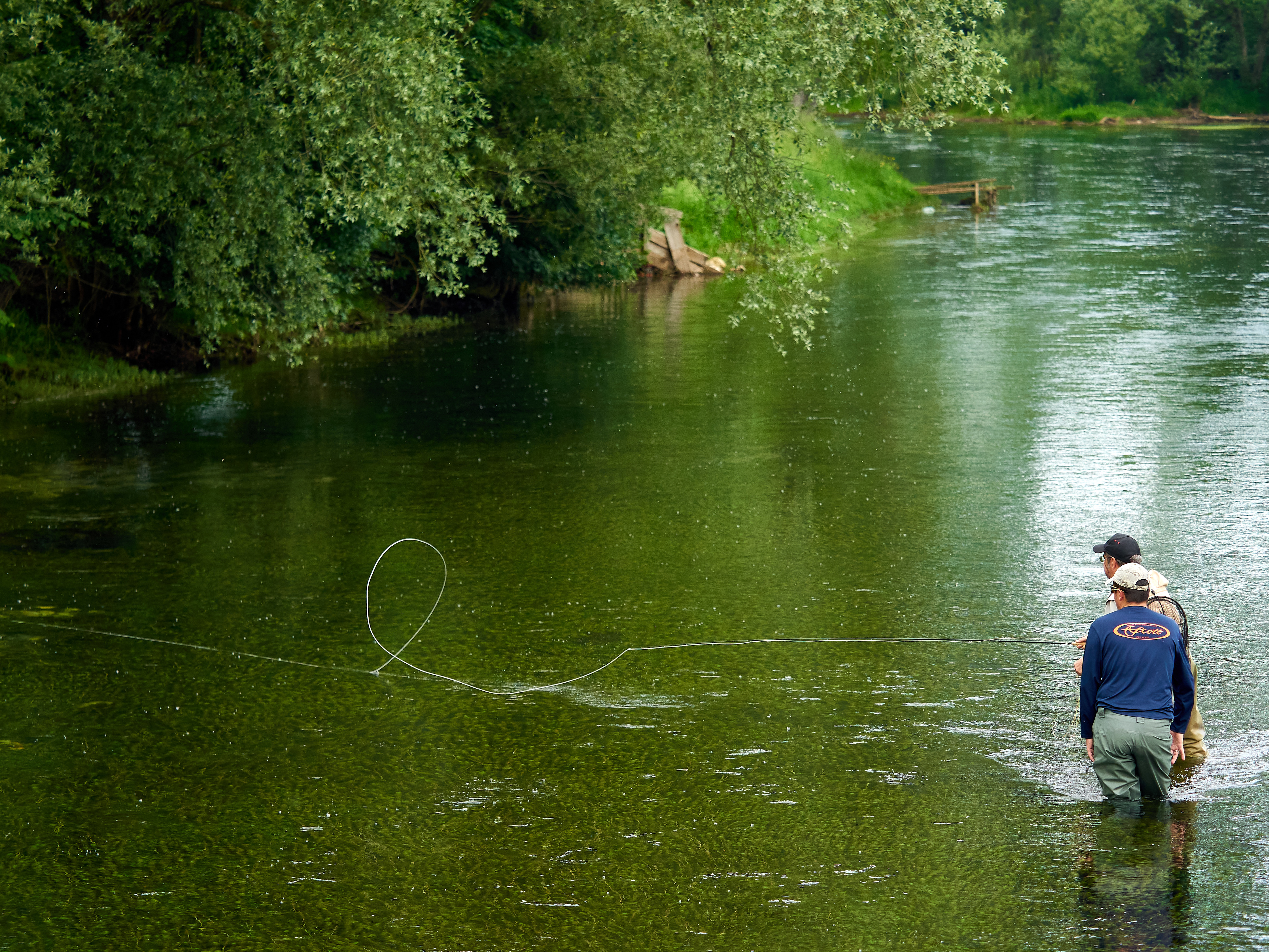
There goes an exaggerated Reach cast well down and across, placing most of the length of the line in the calmer water while the section closest to me drifts on the main flow cutting it at a shallow angle of about 30º. What a difference! I feed line while mending it out towards the slow water as soon as a hint of a belly starts to show up. My fly holds its free drift, and the trout heads purposefully towards my rubber legged foam bug.
When, at last, the fish slides into my net somebody turns the cicadas on. I have no way to check the time but the musical pandemonium, the sun’s position and the vision of those twelve kilometers back to the campervan awake me to another reality: ¡Hurry up! ¡You will arrive by dark, and some young guy will be worried about the old man!

Upstream Dry Fly Only
Many anglers from continental Europe react with amazement to that ancient British rule above, but mainly because of the banning of the nymph, as presenting a dry fly upstream is, in most places, like a non-written rule over here as well.
J. Michael Migel on his work The Masters on the Dry Fly, quoted Ernest Schwiebert:
“The dry-fly code evolved by Marryat and Halford still lives on the Test… The Halford code was quite rigid and unforgiving. All casts should be delivered upstream or quartering across stream, and all techniques were focused on achieving a drag-free float.”
It occurs to me that if you present your fly quartering across, a longish drift will end placing your pattern downstream of your position. Just saying. But I digress.
The fly fishing community of the late 19th century witnessed a famous public controversy between two gentlemen: Mr. Halford and Mr. Skues, who held a heated disagreement about the respective merits of dry fly versus nymph fishing; the dispute went so far —they say—, that it could have been entitled this-chalk-stream-ain’t-big-enough-for-the-both-of-us. Ever since, Halford has been known for his —alleged— ultra-orthodox stance in favour of floating patterns; for that reason, it has also been customary to take him as a scapegoat to purge all the purist whims of anglers of later times.
But, just in case, let’s take a look at what, back in 1886, Halford himself actually thought about how to approach dry fly fishing in a chalk stream. This is what he wrote on his work Floating Flies and How to Dress Them:
“Wherever possible, keep well out of sight by crouching, kneeling down, or wading below the rising fish, and throw the fly upstream so that it lands above the fish at a distance of from one and a half yards to as little as twelve inches…”
But two paragraphs later, he states (the emphasis is mine):
”Occasionally, however, it is impossible, either owing to natural obstructions on the bank or other causes, to fish a spot excepting by casting directly, or nearly directly, down stream; and in such a position a thoroughly dry fly floated down “cocked,” is frequently efficacious…”
“To accomplish this, a good deal more line must be let out than is required to cover the fish, and, in the act of casting, the hand holding the rod must be perceptibly checked so as to pull the fly back and land it on the water with slack line behind it; the hand is then gradually lowered and the fly allowed to “drift” without drag over the rising place of the fish.”
Interestingly enough, Bosnian master fisher Željko Prpić, explained it to me in a very similar way to Halford:
Aitor: long line, short cast.
In summary, Halford’s strict orthodoxy actually did not prevent him from resorting to downstream presentations when the occasion required it. And judging by his accurate description of some basic keys to his execution, it looks to me that this technique was more common in his own fishing than one might suppose.
But let’s go back to Schwiebert and his experience on the Test:
However, it seems proper to confess that I took my best trout with a downstream dry fly. The fish went three pounds and was lying under the upstream frame of a weed-rack. It obviously understood the rules that prohibited casting downstream, since it was impossible to catch by casting upstream or across…
Halford and Marryat would have regarded my presentation an unacceptable heresy, yet skilled American anglers are turning more and more to a downstream float over selective fish.
With all due respect, I must disagree with the author: in view of what Halford himself wrote, I think that far from being scandalized by Schwiebert’s solution, he would applaud it.
In short, no matter how much I dig into literature—classical and contemporary—I cannot find a rational explanation for a rule that is as unique as it is strict. That rigour goes so far that when surfing the net for the rules of a specific stretch of certain British river I came across a curious addition to the main rule:
“The fly, presented upstream, can never drift downstream from the angler’s position.”
In my humble opinion, constraining oneself to observe the river only upstream is just another tradition; and like so many other traditions, as it is perpetuated it ends up losing its meaning —if it ever had any—, to show itself as mere prejudice.
But well, there are also those who consider that a white shirt, tie and tweed jacket is the proper clothing every respectable gentleman should wear when fishing, thus giving the final touch of elegance to the upstream dry fly only motto.
A matter of taste, in the end; and if there’s no accounting for taste everyone can freely choose their own; but in my view, choice should be based on full knowledge of the facts, though.
Dissent
Schwiebert’s recounting of his experiences in England mentioned some fishermen from his native United States, dare enough to break the strict discipline of upstream thinking only.
Many years after Schwiebert’s european trip, during my first visit to Henry’s Fork, I myself was able to see firsthand what the author was referring to; in fact, in that corner of Idaho the rule is the opposite: Downstream dry fly. There is a difference, though: on Henry’s Fork no one intends to impose that rule… except for the picky rainbows that populate it, that’s it.
A look at the scenario of that river’s most famous stretch, the Railroad Ranch, reveals a vast grassy, treeless plain. The channel, of considerable width, relatively shallow, with a uniform bottom of fine gravel offering easy wading, writhes like the molting of an enormous snake. In short, no visible impediment to hinder the presentation of our fly; according to old Halford’s philosophy there would therefore be no justification for a downstream approach. But this apparent lack of obstacles is nothing more than an illusion: it is enough to present your fly a few times to discover that the hidden problem is the current itself, or rather, the motley scene of indecipherable currents that weave and unweave themselves on a liquid tapestry of illusorily smoothness.
The difficulties are not in form of dead logs crossing the current or beaver dams… simply because there are none. The actual obstacles cannot be seen at first glance, because they are submerged: the thick layer of underwater vegetation, cut here and there by unpredictable channels that divide the green mass in different clumps, generates a chaotic hydraulics that manifests itself in a tangle of veins of current, bent on ruining any attempt at a dead drift; a common phenomenon in other limestone rivers… but not only on them.
As Gary Borger wrote in his work Fishing the Film (2010):
“The downstream and across presentation tactic is so effective that for me it is the number one method of presenting a dry fly, whatever the scenario.”
And he continues:
“The advantages of a downstream across dead drift presentation are:
1.- The fly gets to the fish before line and leader.
2.- Done right, it also keeps the line far enough away so that the fish is not spooked by it.
3.- It is probably the most effective way to really get the dead drift that is so necessary to take highly selective fish.
4.- And, as it turns out, it’s also the best way to get the fly into the fish’s feeding lane every cast.”
Personally, I would add one more advantage to all those listed above: the possibility of ultra long dead drifts by feeding more fly line to the water; something especially useful when fishing blind on some big waters.
All in all, in my opinion, the most important benefit of the downstream technique is its unique ease of achieving presentations that are unthinkable otherwise, especially in those convoluted scenarios where a correct drift is specially hard to achieve.
It is not surprising then that Mike Lawson —born and raised on the Henry’s Fork and considered the greatest expert on that river— in his book Spring Creeks offers technical illustrations that, for the most part, show an angler presenting his fly downstream.
I came across the downstream approach again quite a few years later, during my first fishing trip to Slovenia. There, I was shown by an experienced fisherman the big difference it makes addressing a deep pool from an upstream position, instead of downstream: long, free drifts managed to pull grayling up from the bottom.
What had sounded so strange to me on the Henry’s Fork was now starting to make sense.
Subsequent trips showed that the downstream heresy was more popular than I supposed. In the Balkans, far from being a minor occasional tactic, is the technique of reference; more recently I saw quite a few of its practitioners on Norwegian Glomma or French La Dordogne rivers also.
Problem
No matter how smooth it may look, the flow of a river is not completely even. It is true that in some circumstances it can exhibit quite a laminar flow with water moving in parallel layers without much intermingling, each particle following a relatively uniform path, but that is a rare occurrence. Much more common is a more or less turbulent flow, characterized by an irregular motion of the fluid particles. In short, a river’s mass of water is not something monolithic and indistinct, but rather a continuous interweaving of veins of different width, speed and direction.
Not every river neither all sections of each one are equally turbulent, of course, but it is worth keeping in mind that no matter how placid it may seem, the nature of a stream is more a chaos of liquid threads than a smooth tapestry of uniform and perfectly aligned warp.
The speed and direction of the current vary considerably across the width of a water course due to friction against the bottom and both banks; those parameters are especially affected by obstacles present on the stream bed, such as large stones, logs or weed beds. This last factor —underwater vegetation— is the hallmark of chalk streams and spring creeks, an ideal habitat for aquatic macroinvertebrates whose abundance is, in turn, a gift for both fish and fishermen. But in this lush submerged vegetation also lies the source of multiple and labyrinthine patterns of current —the closer to the surface the vegetation is, the craziest those patterns are—, that pose special difficulties when it comes to set our fly on a dead drift course. They are therefore the ideal scenario —although not the exclusive one— to put the downstream presentation approach into practice.
The sheer abundance of literature on fishing entomology and tying methods for fly patterns, is in sharp contrast to the scant information on what to do for such refined imitations to behave naturally. It is not strange to observe anglers oblivious to the subtleties of dragging, knotting fly after fly without having ascertained whether the drift of those discarded patterns was actually acceptable in the first place. Oddly enough, a good number of fishers aren’t aware of the fact that, when dealing with demanding fish, the most subtle of tensions in our line/leader will mean failure, and that for any tension to be a problem it does not need to get the fly started into water skiing: if our artificial fly drifts a tad slower, a bit faster or deviates minimally from the course stablished by the current tongue in which it is floating, it is enough for the fish to lose interest —if it ever shows any in the first place. In the worst case scenario, you may stomp upon fish so sensitive to the behaviour of natural insects that any anomaly in the path of that infallible pattern of yours suffice to spook them; —by the way, if that pattern is infallible what are the other two hundred flies in your box for?
Curiously enough, in many cases fish apparently aren’t as discerning as we might think. Last summer on Norway’s Glomma river, when gutting a grayling from the morning session for lunch, we were surprised by a big cigarette stub coming out his stomach!
I recently stomped upon some old, forgotten notes, a sort of fishing log I used to keep. A brief summary of the 2001 opening day on a local river is particularly interesting. It goes like this:
“I spotted a nice, active brown trout from the bridge; then the fish rose, took, chewed and eventually spitted… a wine cork stopper!”
I must add that all my subsequent attempts to fool the fish to take one of my flies were utterly ignored. That fact, apart from showing about my lack of skill, points out some weird issue: at times, a cork stopper may result more appealing than a well tested fly pattern.
This past season I was on my local river shooting some footage of big barbel actively rising. The best clip of the series showed a close-up view of a fish which was frantically chomping invisible midges. Only after editing the clip I noticed that one of the morsels that barbel confidently took was a thin, and long, piece of floating vegetal stuff with an orange shade.
If we look for a single trait common to all those diverse floating things that trout take into their mouths —be they insects or some odder materials—, what we have is, simply, a drag-free drift. If they drift freely, even twigs, wine corks or cigarette stubs can bear resemblance to some food item in the eyes of the fish. Material to reflect on the necessity of the utmost accuracy in our fly patterns. But that is another topic.
Does this mean that presentation trumps imitation? Well, after so many years of sterile debate my opinion is that all those arguments were based on a false dichotomy in the first place: presentation and imitation are so closely related as the two sides of a coin.
It would be foolish to offer a size #12 Mayfly pattern during a midge hatch. On the other hand, presentation is the key element that will decide the behavior of our fly in the water, and behavior is an intrinsic part of the essence of any living being. Thus, in general, a fly pattern that does not follow the direction and speed of the current it is riding on is not a good imitation of anything, no matter how real its size, shape and colour may look.
Think of David, Michelangelo Buonarroti’s sculpture masterpiece. Notwithstanding the perfect representation of every muscle of the human body, no one has ever taken it for a real man because he doesn’t move nor breathe, he doesn’t even blink an eye.
As Paul Gaskell states in his The Nature of Fly Fishing:
“It is perfectly possible to present the “wrong” fly well and have a fish take it. It is much more difficult to offer the “right” fly with bad presentation and still catch the fish”.
In fly fishing, the connection with our lure is not a very thin piece of monofilament but the fly line, a string of enormous weight compared to the fraction of a gram some of our patterns weigh. In the case of a tug-of-war between fly line and fly imagine what the bets would be. And that is precisely what we confront when presenting the entire system of line/leader/fly: when the line touches the water different sections along its length may occupy different current tongues of varying velocities. Those differences result in some parts of the system pulling on other parts. If the fly line moves faster it will eventually move the leader and fly in some weird way. If it is the fly and leader what drifts faster they will try to pull on the line, with the same unwanted result.
In short, a dragging fly is an unsolicited visitor that sooner than later will knock at the door. Thus, and since presentation and imitation are one and the same, do study the drift of your fly very carefully before thinking about a pattern change; and I mean to study it, which is much more than a casual look; because it is not about looking for water skiing displays, but rather about discerning the slightest tension in your fly drift.
By developing this awareness you might eventually find yourself carrying a significantly smaller number of fly boxes with you.
Solution
To put the problem of a drag-free fly drift into perspective several basic aspects should be taken into account:
1.- Strive to present your fly line in a way that it crosses as few different current veins as possible. If the whole combo of fly line, leader and fly drifts in a single water lane all its elements will move at the same speed.
2.- Pulling on one end of a string eventually displaces the other end… if the string is straight in the first place. This concept is the reason why slack line is so important. But putting slack at random is not reliable; placing is key: the slack that matters the most is the one which is positioned as close to the fly as possible.
3.- If you push one end of a flexible string —fly line and/or monofilament, for instance—the opposite end does not move. Based on this piece of common sense, in our two-part system, fly line and leader/fly, the part that rides in the faster water should be presented upstream of the section that occupies the slower current. In this way we challenge the faster element of the system to try to push on the string; it is not that easy for it to affect the other end of the string now.
In many situations the best way to put this concept into practice is by presenting your fly downstream. Did you notice that every time that you present your fly directly across the stream with a Reach cast you are in fact performing a downstream presentation?
The downstream approach is not about changing paradigms or creating a new dogma, but simply about expanding our toolbox, and also our vision, to make us more adaptable.

Epilogue
As I make the final corrections to this piece I linger over that kiwi trout whose story starts this article, reflecting on how the too common motto it’s always been done this way has never been a driving force for progress or improvement. Had I done things the way they’ve always been done I wouldn’t have had the opportunity to enjoy that fish, the culmination of a particularly tough day that became worthy of remembrance.
And so —maybe— one day you’ll reach that tree that shelters the undercut bank whose overhanging branches are speckled with the remains of flies fallen in action; cover for —maybe— the dwelling place of a good fish. And —maybe— you’ll notice that at some point upstream the tangle of branches gets thinner until it vanishes itself; and that placing yourself upstream from that window in the riparian vegetation, presenting your fly in the right current lane will no longer resemble the practice of an apprentice juggler. Maybe your rod will follow the perfect drift of your fly downstream, towards the shadow at the end of the tunnel. You —maybe— will be surprised to see a big, confident mouth appear; maybe your surprise won’t break your composure and you’ll hold on just long enough not to deprive the fish of its meal. Maybe.

